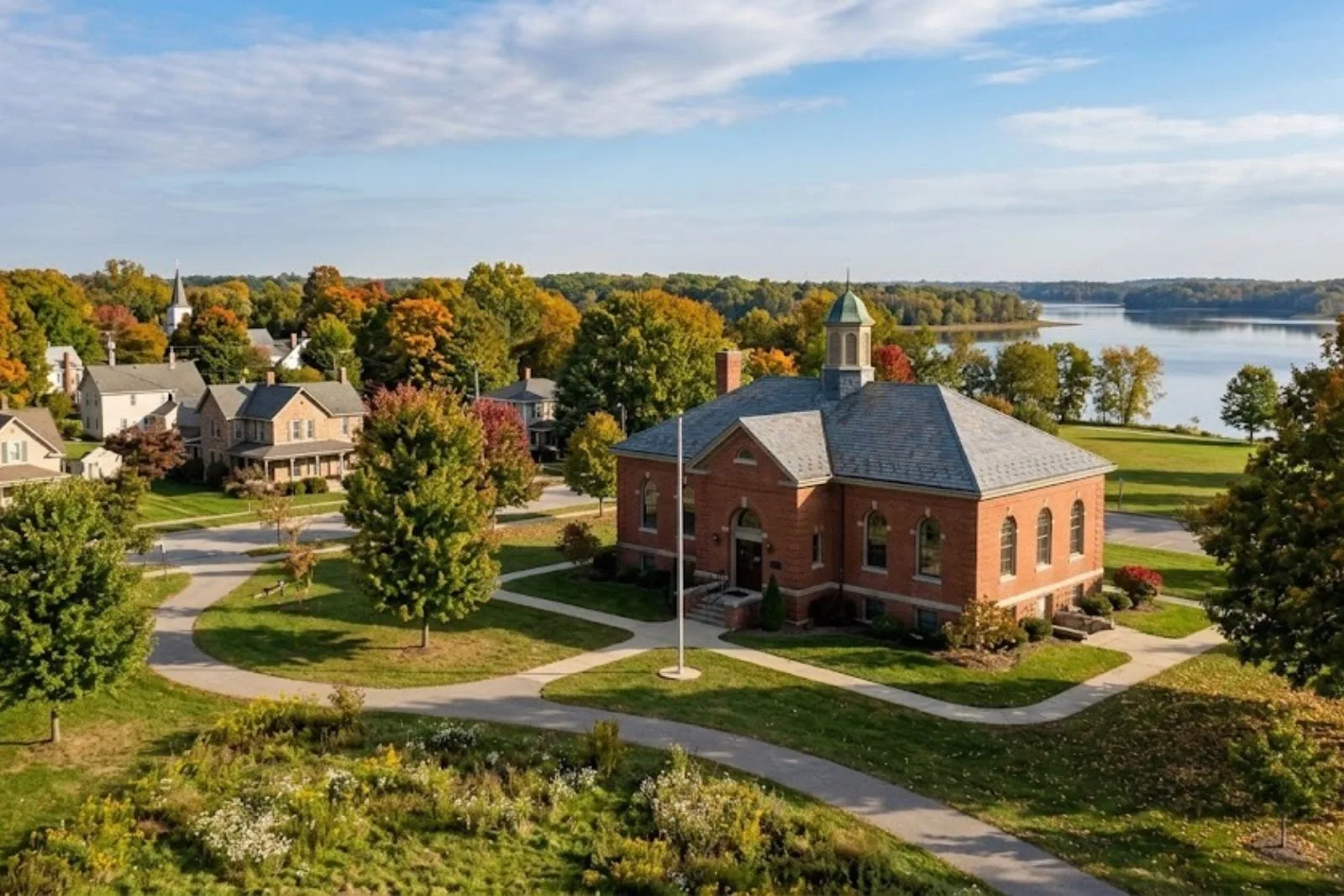
A Village Laid Out in 1849 at the Northern Edge of the County
Ashley was laid out in 1849 and named for L. Ashley, one of the original owners of the village site. About 1,200 people live in the village, which sits in Oxford Township a few miles from the Morrow County line, and students attend Buckeye Valley Local Schools.
That small-town scale shapes the plumbing work. Housing here leans toward older village homes, farmhouses, and rural lots rather than large subdivisions, and utility setups vary from one address to the next. When you call, we ask whether you are on village service, a private well, or septic so the right equipment is on the truck.
Around the Village Center: Wornstaff Library, the Municipal Building, and Older Homes
The village center includes the Wornstaff Memorial Public Library, the Ashley Municipal Building, and the Ashley Union Cemetery nearby. The homes around them were built long before modern supply piping, and original galvanized lines and cast iron drains are the usual findings in houses of that age.
In those houses we look first at supply lines for corrosion, then at the age of the water heater, since a tank installed twenty years ago is living on borrowed time. Replacing aging pipe before it fails is almost always cheaper than repairing the water damage afterward.
Wells, Septic Systems, and Rural Addresses Around Ashley
Outside the village limits, properties in Oxford Township and the neighboring townships commonly rely on private wells and septic systems, as in much of northern Delaware County. Well water brings pressure tanks, pumps, and mineral content that differ from municipal supply.
A failing pressure tank cycles on and off every few seconds, and a septic system that has gone years without pumping shows up as slow drains and soggy ground over the drain field. Both are cheaper to catch early. We pump septic tanks and service well-fed plumbing, and we ask about your setup at dispatch.
Delaware Lake, Low Spots, and Basement Moisture
Delaware Lake and Delaware State Park lie southwest of the village, and the flat farmland in between holds water after a hard rain or a spring thaw. Basements in low spots take on water first, and a sump pump that sat idle all winter is the usual culprit.
We test the pump under load, check the discharge line for ice or blockage, and price a battery backup for homes where the power tends to fail when the storm arrives. A rural address that loses power for hours needs that backup more than a house on a village grid.
How Far North We Go and What to Expect
Ashley is roughly twelve road miles north-northeast of downtown Delaware, and our emergency line treats it as part of the regular service area, not a special trip. We dispatch the nearest available crew and give you a real arrival window for your address.
For farm properties with a house plus outbuildings, tell us which structures have water. A barn spigot, a detached garage with a drain, and a main house on a separate line each affect what we bring and how we price the visit.
Emergency Dispatch Around the Clock in ZIP 43003
Every Ashley address and the rural roads around it fall inside ZIP 43003, and our emergency dispatch covers all of it at any hour. A frozen well line in January gets the same response as a water heater failure in the middle of a summer night.
We also serve the nearby 43015, 43066, and 43074 ZIP codes, and we pair that reach with the septic and water heater work that northern Delaware County properties call about most.